
















 Sports Travel
Two Events, One Trip: How to Plan a Multi-Sport Weekend
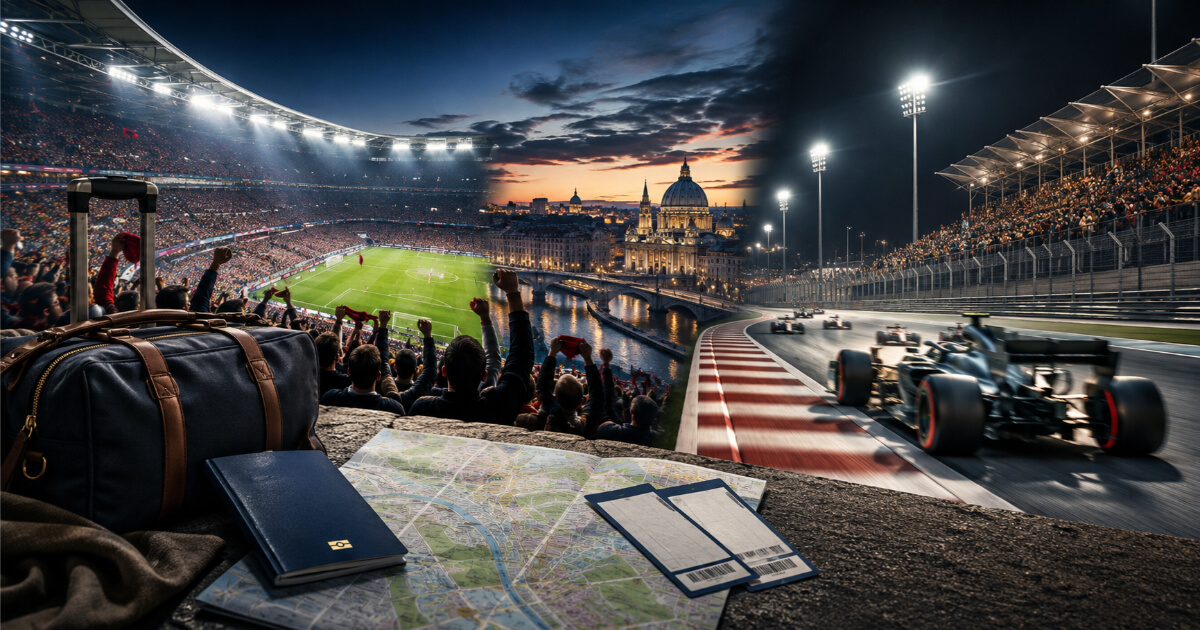
Most sports trips are built around a single ticket. You choose one event, you book a flight, you go home. There is a more rewarding way to travel, and the European calendar in late 2026 makes it unusually easy: fit two ticketed events into one trip. A Friday night football match and a Sunday motor race. A league game and a midweek European tie. The same flight, the same hotel, two events instead of one.
Why the autumn 2026 calendar helps
The 2026 World Cup pushed the European club season back, and the major leagues did not all restart on the same weekend. La Liga began on 14 August, the Premier League on 21 August, Serie A on 23 August and the Bundesliga on 28 August. Instead of one crowded opening weekend, there is a full month of staggered starts, which creates more weekends where one league is already running and another is only beginning.
September adds more options. The Champions League league phase opens on 8–10 September. Formula 1 races at Monza on 4–6 September, in Madrid on 11–13 September and in Baku on 24–26 September. The US Open runs in New York from 23 August to 13 September. Several of these overlap, and that overlap is the opportunity.
Start with the fixed date, then book everything else
In any pair of events, one date is harder to move than the other. A Grand Prix weekend is set. A tennis session is set. A football fixture is not.
Kick-off times are confirmed late
This is the most common mistake in multi-event planning. League matches are not played only on Saturday and Sunday. Broadcasters move fixtures to Friday evenings and Monday nights, and European competition can shift a domestic match by a day or more. A game that appears on a Saturday afternoon when the fixture list is published may end up being played on the Monday.
So lock the immovable event first, and treat the football match as flexible until the broadcast schedule is confirmed. Keep at least one spare night in the trip, and do not book a flight home that departs a few hours after a kick-off time nobody has confirmed yet.
Three pairings that work
Milan and Monza
The Monza circuit is roughly half an hour north of Milan by train, and is there on 4–6 September. Milan is also a city with two clubs, so a race weekend can be extended in either direction with a league match. One city, one hotel, two very different atmospheres.
Madrid in mid-September
Formula 1 races in Madrid on 11–13 September. Madrid is also a city with more than one club, so it is worth checking whether a league matchday falls on the same weekend or on one of the weekends either side. Almost everything is reachable on the city's metro, which keeps the logistics simple and the taxi budget small.
A weekend match plus a midweek European night
league phase matches are played on Tuesdays and Wednesdays. That creates a pattern experienced travellers use often: arrive for a weekend league match in one city, take a short flight or train on the Monday, and watch a European tie on the Tuesday or Wednesday. Two competitions in one trip, and midweek hotel rates are usually lower than weekend rates.
Four rules for a two-event trip
Buy the harder ticket first
In every pair, one ticket is scarcer than the other. Grand Prix grandstands, matches involving the biggest clubs and late-round tennis sessions sell out earliest. Secure that ticket, then build the second event around it. Doing it in the opposite order is how people end up with flights booked and no seat at the event they actually came for.
Measure travel time between venues, not distance
Two cities 300 kilometres apart can be ninety minutes by direct train or five hours with a connection. Check the actual service on the actual date, because European timetables thin out on Sundays and public holidays. A route that looks easy on a map can quietly consume half a day.
Plan for two sets of entry rules
Every venue has its own policy on bag size, bottles, cameras and re-entry, and the rules at a circuit are not the rules at a football stadium. Read both before you leave the hotel rather than at the gate, and allow extra time at the larger of the two venues.
Leave one day empty
A two-event trip has very little slack in it. A delayed train, a postponed fixture or a long security queue can cost you the second ticket. One day with nothing scheduled absorbs almost every problem a sports trip can produce, and if nothing goes wrong you have a free day in a new city.
How to start planning
Work outward from the fixed event. Pick the race, the tennis session or the European night that cannot move, then look for a league match within a few days of it, and only then book the travel. If you would rather start from the football, the and the other league pages are a good place to see which dates are already on sale.
Two events in one trip asks for a little more planning and very little more money. Browse what is available for the weeks ahead, find two dates that sit close together, and turn a weekend away into the trip you will still be describing years from now.